

If you’ve been anywhere near TikTok or YouTube lately, you’ve probably seen clips from IShowSpeed’s Africa tour filling your feed. His livestream journey across the continent has been incredibly diverse, energetic, and genuinely moving—and for our classroom, it’s felt like an amazing albeit unexpected gift. We've been traveling Africa alongside him and here's how you can too.

iShowSpeed (real name Darren Watkins Jr.) is one of the most-watched streamers on the internet. He rose to fame through high-energy livestreams on YouTube and Twitch, where millions of fans tune in for his unfiltered reactions, humor, curiosity, and genuine engagement with the world around him.
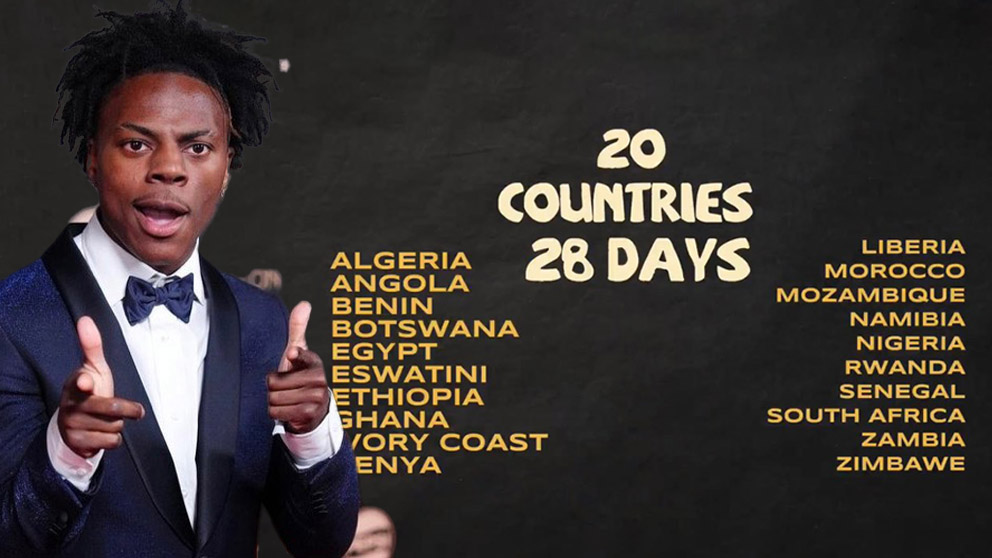
Over the course of several weeks, he is traveling across 20 countries on the African continent, livestreaming large portions of the journey and sharing highlights across TikTok, YouTube, and other platforms.
What makes the tour stand out isn’t just the scale—it’s the accessibility. Fans aren’t watching Africa through a documentary lens or a history textbook; they’re seeing everyday life, modern cities, neighborhoods, landmarks, music, and people as they exist right now, through a creator they already trust and follow.
For many viewers—especially Black American youth—this has been eye-opening, surprising, and deeply affirming.

The timing couldn’t be better. Speed’s tour started in early January, right as we’re working through two full months of Black History deep dives and unit studies.
Instead of starting Black History Month with only textbooks or documentaries, we get to follow a real, unfolding journey—watching Africa as it is right now, through the eyes of someone our students already know, follow, and trust.
Africa 101
We began by introducing the tour and grounding ourselves with just five basic facts about Africa.
The five facts are:
- Africa has 54 countries and over 2,000 languages.
- All humans originally came from Africa.
- Africa has billionaire CEOS and major global businesses.
- Africa has animals found nowhere else on Earth.
- Africa has snow, deserts and tropical beaches.
They wrote those facts in their Genius Journals. And then we watched this video to add to our burgeoning new worldview on Africa.
Some students realized they’d been carrying misconceptions they didn’t even know they had. Africa began to feel less abstract and more connected to real people and lived experiences.
Where is Speed on the Map?
Next, we pulled out a blank map of Africa and looked at where Speed traveled.

I said each country name aloud, and the students repeated it back—call and response style. Some names were easy. Some were hard. But pronunciation matters.
Then we stood in front of our giant world map and talked about regions—Southern Africa, East Africa, North Africa, West Africa—and how Speed grouped his journey geographically. We focused only on the 20 countries he’s visiting, labeling just those on our maps so students could clearly see where he’s been and how his path across the continent is unfolding.
It took time. Students had to hunt for countries they’d never located before. Honestly, I wished I’d printed a completed reference map—having them transfer just those countries to a blank map would still have been challenging—but the struggle itself was good practice.
The Four-Color Map Challenge
The next day, we turned geography into a logic puzzle with a map-coloring challenge, introducing the Four Color Theorem—the idea that any map can be colored with just four colors so that no two neighboring regions share the same color.
Some students managed it. Others ran into tricky border cases—tiny slivers of land that touch in non-obvious ways—and ended up needing five or six colors. That led to great problem-solving discussions and a lot of quiet, focused effort. I’ll be sharing photos because the finished maps were genuinely impressive.
Watching Speed's Clips
Speed also has excellent clippers—people who know how to catch the best moments fast and clean—which made this part easy. I was able to pull together a safe-for-school TikTok playlist with some of the most interesting, joyful, and eye-opening moments from the tour.
👉 Watch our curated TikTok playlist of Speed's Africa tour.
It’s a simple way to travel alongside the tour, revisit specific moments, and keep the learning going beyond a single lesson or class period.
Eating Across the Diaspora
As we’ve been following Speed’s journey, we decided not to just watch Africa—we wanted to taste our way through it, too. Because a place isn’t only geography or history. A place lives in its food.
We started with Ethiopian food, inspired by dishes Speed ate on the tour: lentils, vegetables, and injera. For some students, this was their first time eating with injera, learning how food can be shared, torn, dipped, and eaten communally. For others, it was familiar—and those students stepped into the role of guide, explaining flavors, textures, and traditions to their classmates. That moment alone shifted the room: knowledge didn’t just come from a book or a teacher, but from lived experience.

From there, we moved west to West African jollof rice and plantains—a dish many students had heard passionately debated online (whose jollof is best?) but hadn’t always connected to a specific region or history. Suddenly, jollof wasn’t just “that rice everyone argues about.” It was Nigeria. Ghana. Senegal. Community. Celebration. Flavor tied to place.

Next on our list: couscous, a staple across North Africa, and foods from the Caribbean, tracing how African foodways traveled, transformed, and took root across the diaspora. These meals help students see the throughline—how culture moves, adapts, and survives across continents and centuries.
This has been one of the most powerful parts of the unit.
Because you can memorize facts about a place and still feel disconnected from it. But when you eat the food—when you smell it, touch it, share it, talk about it—you build a different kind of understanding. Food turns “over there” into here. It turns curiosity into connection.
Why This Matters
Speed’s tour has opened doors.
Students loved seeing modern cities, malls, homes, streets, statues, and everyday life—not just the narrow images they’d absorbed before. They connected monuments like the pyramids to real places and living people. They noticed pride, style, music, language, and joy.

Most importantly, they watched someone model curiosity without fear or judgment. Speed wasn’t standoffish or nervous. He was open. Excited. Respectful. Constantly saying, “This is so cool. I want to learn more.”
And our students followed his lead—confidently.
That’s the power of representation, timing, and real-world learning intersecting. This tour isn’t just entertainment. For our classroom, it’s become a living pathway into deeper understanding of Africa, Black history, and global culture—right when it matters most.